
We skipped last week’s update. The reason: we were heads-down shipping the largest release since testnet launched, and writing about it would have slowed it down. RFQ trading, multi-leg strategy building, P&L attribution on your equity chart, a two-phase liquidation system, and a complete mobile app overhaul.
Tl;dr
- RFQ trading is live. List new assets without liquidity constraints, fall back to limit orders when no quotes. Auto-execute with one signature
- Multi-leg order builder with 28 auto-detected strategies, combined payoff chart, and URL-shareable legs
- P&L attribution layers on the equity chart show which positions drove your returns
- Two-phase liquidation system is live: partial close orders first, on-chain auction if needed
- PWA overhaul: root routes, iOS splash screens, wake lock, app shortcuts
- Desktop polish: expandable markets panel, breadcrumbs, account hover menu, rank chip, help button
- Dynamic social preview images for every shareable page
Competition Update
The April 2026 Trading Competition runs through May 1. $1,000 in SYN prizes ($500 / $300 / $200).
TurboLongSyn holds the top spot at +$904K on just $54K of volume. That is a 16.9x efficiency ratio, meaning every dollar of volume generated roughly $17 of realized P&L. The top two wallets together account for nearly $1.8M in profit. The number two trader is even more capital-efficient at 19.5x, running the tightest book on the leaderboard.
Request for Quote (RFQ)
RFQ is live. This is what lets us list new assets fast without waiting for organic orderbook liquidity to build up. You can trade options on US500, USOIL, GOLD, HYPE, or anything else we list, and the market maker will quote you a price in real-time. If the quote is good, you take it. If no quotes come back, the system falls back to a limit order on the orderbook. Either way, you get execution.
The entire flow runs over a single WebSocket connection: submit an RFQ, receive quotes pushed in real-time, accept with one click.
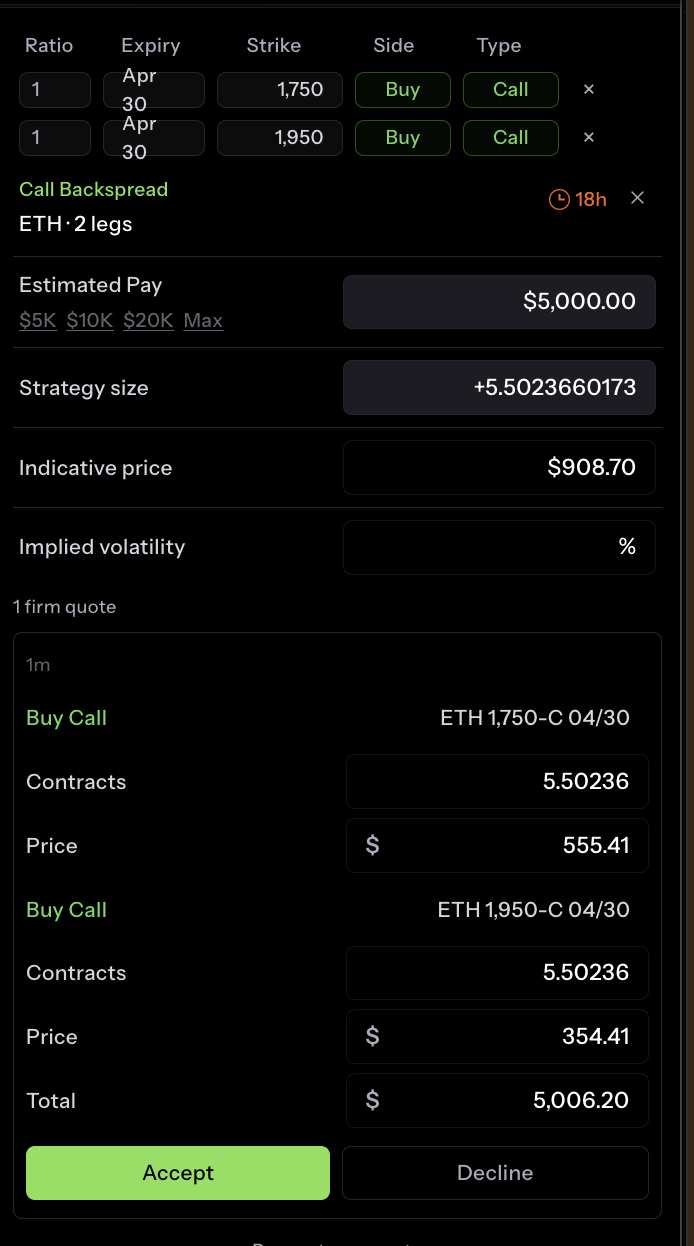
Auto-execute mode takes it one step further. You pre-authorize a limit price via an EIP-712 signature. When the first market maker quote arrives within your limit, it executes immediately. One signature, one round trip. If no quotes arrive or all quotes exceed your limit, the system falls back to placing a limit order on the orderbook. You always get execution.
This is the single largest piece of infrastructure we have shipped.
Multi-Leg Order Builder
Clicking options in the chain now adds them as legs to a multi-leg order form instead of navigating to a single instrument view. The UI auto-detects the strategy name and renders a combined theo chart, payoff diagram, and aggregated greeks.
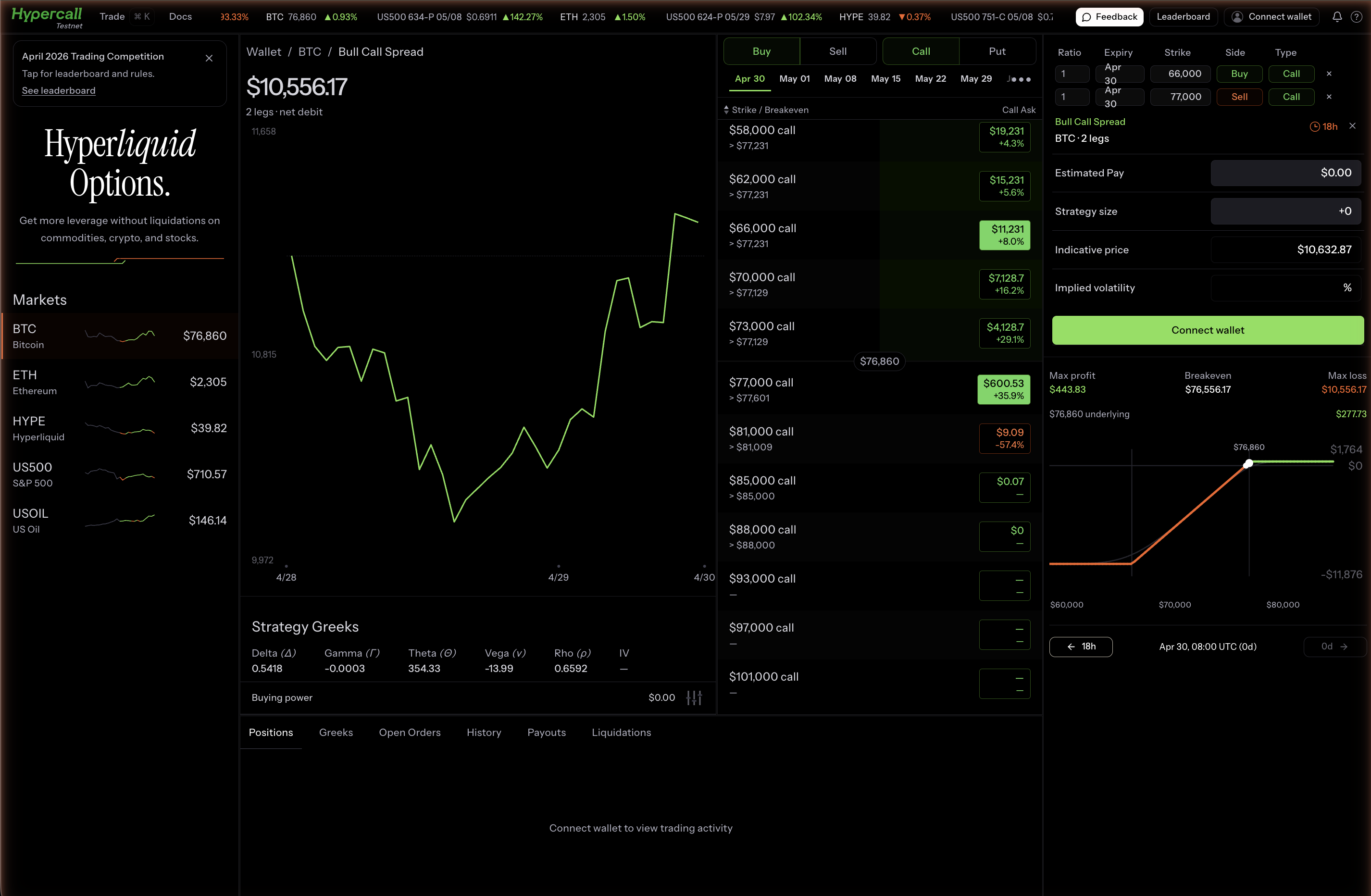
We detect 28 strategy types: vertical spreads, straddles, strangles, iron condors, butterflies, calendar spreads, risk reversals, collars, ratio spreads, box spreads, jade lizards, seagulls, and more. Each strategy name shows a tooltip linking to its docs page.
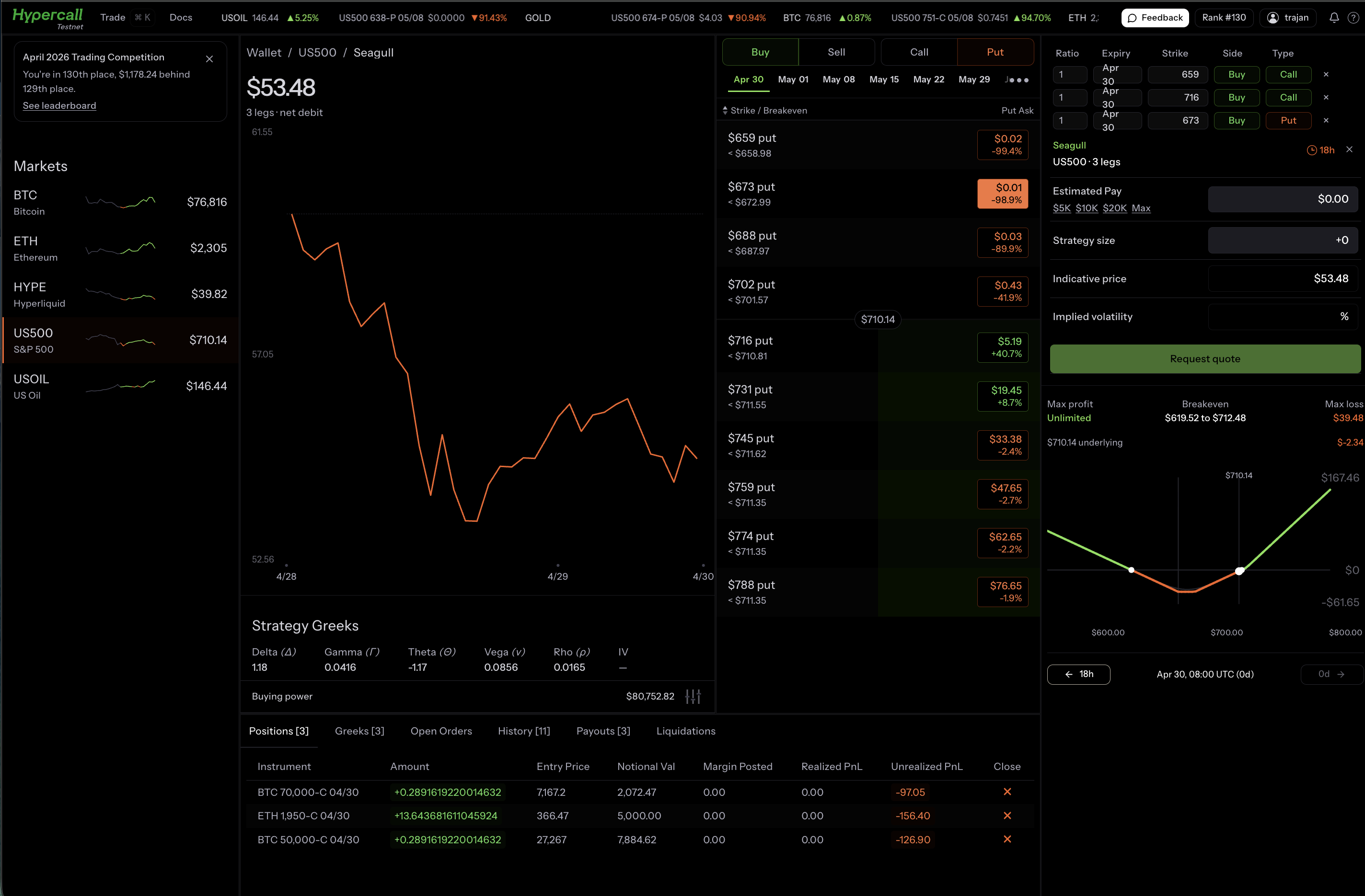
Legs persist in the URL (?legs=INSTR:Side,INSTR:Side), so you can share a pre-built strategy with a link. Combined greeks aggregate across all legs with sign adjustment for sell sides, so you see the net delta/gamma/theta/vega of the whole structure.
Max legs went from 4 to 10 to accommodate more complex structures. Strategy detection works on both desktop and mobile.
P&L Attribution
A layers icon now sits next to the competition badge on the portfolio page. Toggle it on and the equity chart becomes a stacked area showing which positions contributed to your P&L over time. Below the chart, a horizontal bar breakdown groups positions by underlying with per-symbol realized P&L.
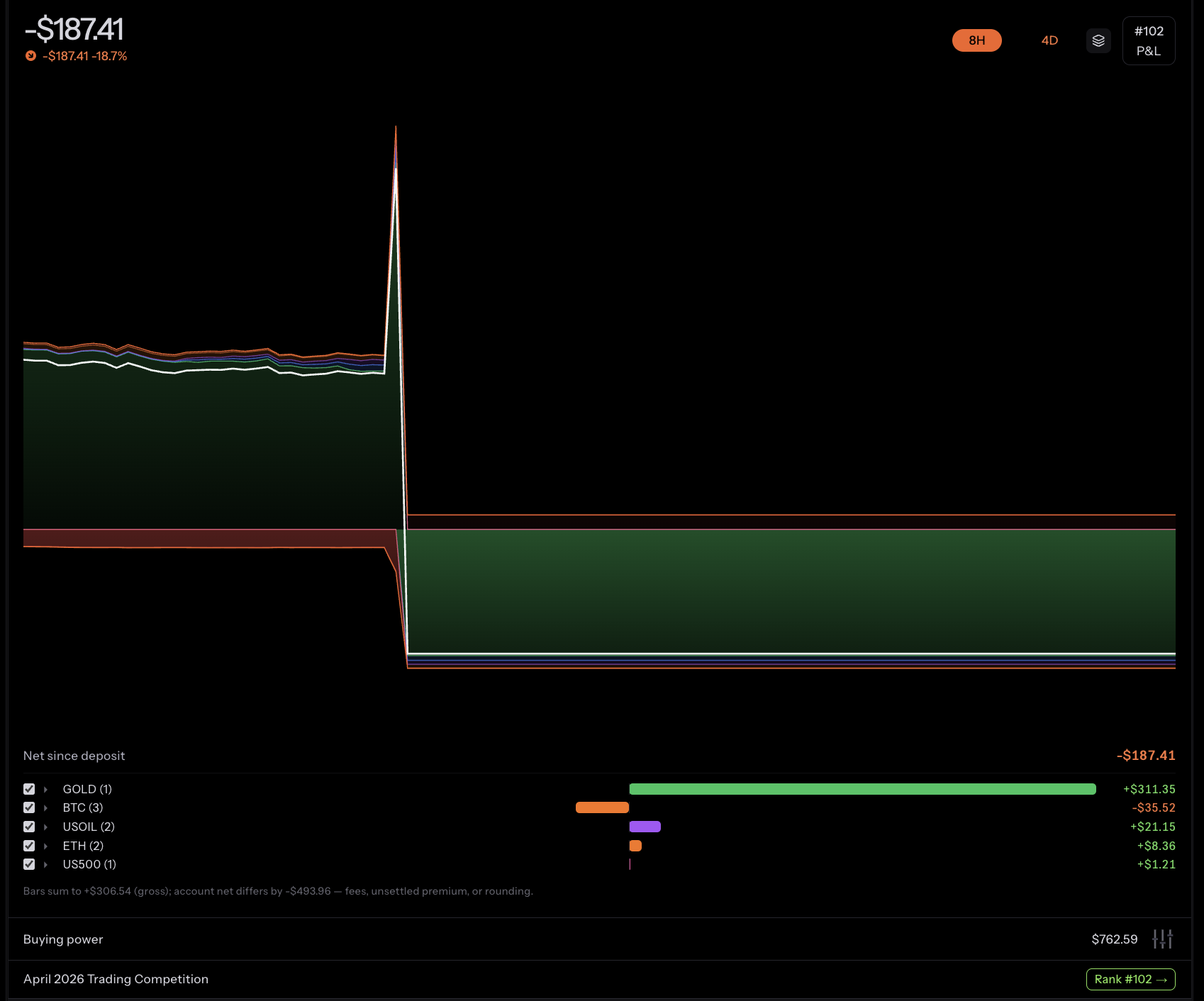
Hover a row in the breakdown to highlight that position’s band on the chart. Click the chart to pin a point in time and inspect the composition. Uncheck positions to see “what if” scenarios: hide a losing position to see what your curve would look like without it. Deposit and withdrawal events are marked on the zero baseline with arrows.
Positions show friendly names (“BTC $55,000 Call Apr 14” instead of “BTC-20260414-55000-C”) and auto-detect strategy groupings within each underlying.
Liquidation System
The two-phase liquidation system is now live on testnet. When a wallet’s margin ratio drops below the maintenance threshold:
- Partial liquidation fires first. The backend places IOC close orders to reduce the position enough to restore margin health.
- Full liquidation escalates if partial close is insufficient. The account enters an on-chain auction where third-party liquidators can bid for the position.
Desktop Polish
Several smaller changes that make the desktop layout more usable day-to-day.
Expandable markets panel. The left sidebar now collapses, giving the chart and options chain more room. Breadcrumbs show your navigation path (Wallet / BTC / Bull Call Spread) so you always know where you are.
Account hover menu. Hovering the profile button shows equity, P&L, buying power, and position count at a glance. Users who have not set a username see a “Choose name” prompt.
Rank chip. The leaderboard link in the navbar is now a live rank badge showing your current standing with delta indicators (up/down arrows with count). Rank updates arrive via WebSocket as you trade.
Notifications bell. Replaced the announcements megaphone with a bell icon. Tabbed dropdown: Notifications (fills for now) and Announcements. Unread dot renders on first paint via SSR.
Help and service status. A help button links to docs. A red “Service Unavailable” chip appears when the backend is unreachable.
Social Preview Images
Every shareable page now generates a branded OG image with live data. Share a trade link and the preview card shows the instrument’s theo chart, greeks, and current price. Share the leaderboard and you see the top 5 with medal badges.
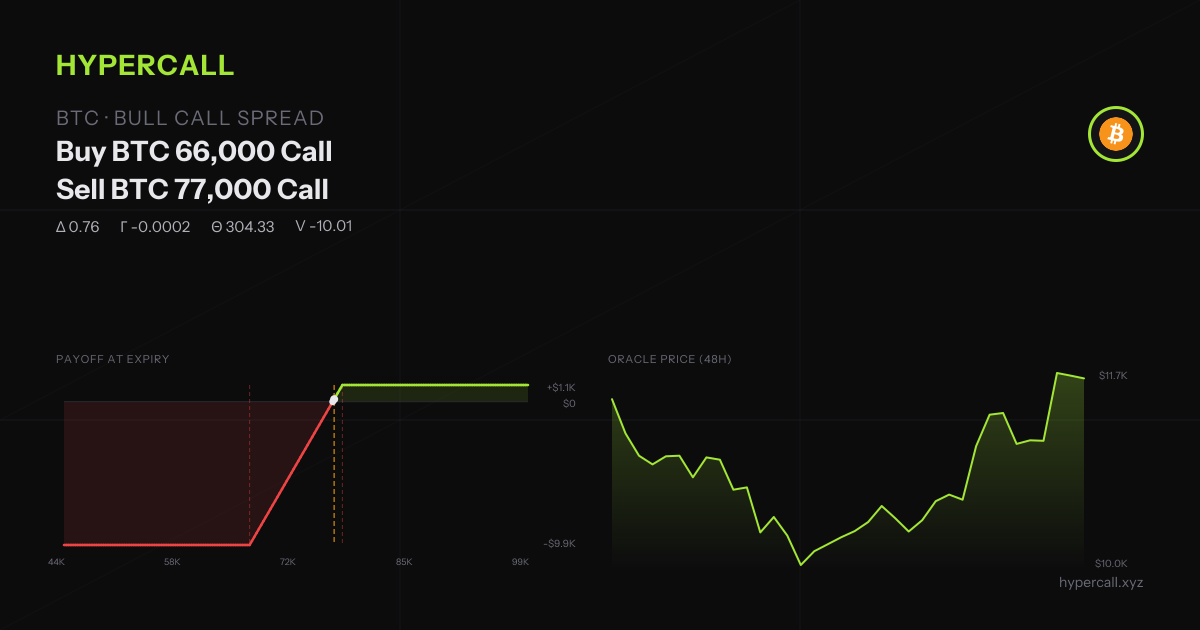
Pages covered: asset pages, options chains, individual instruments, multi-leg strategies (shows payoff diagram + auto-detected strategy name), member profiles (P&L + rank), leaderboard, and trade confirmations.
Mobile App Overhaul
The mobile PWA moved from /mobile/* routes to root /*. Every URL is now canonical and shareable without the /mobile prefix. Legacy paths redirect automatically.
Users who installed the old PWA get a native-style upgrade flow. On iOS, tapping the old icon opens a clean upgrade screen with a single Install button that walks you through re-adding from Safari. On Android, a single-tap install button opens the new version.
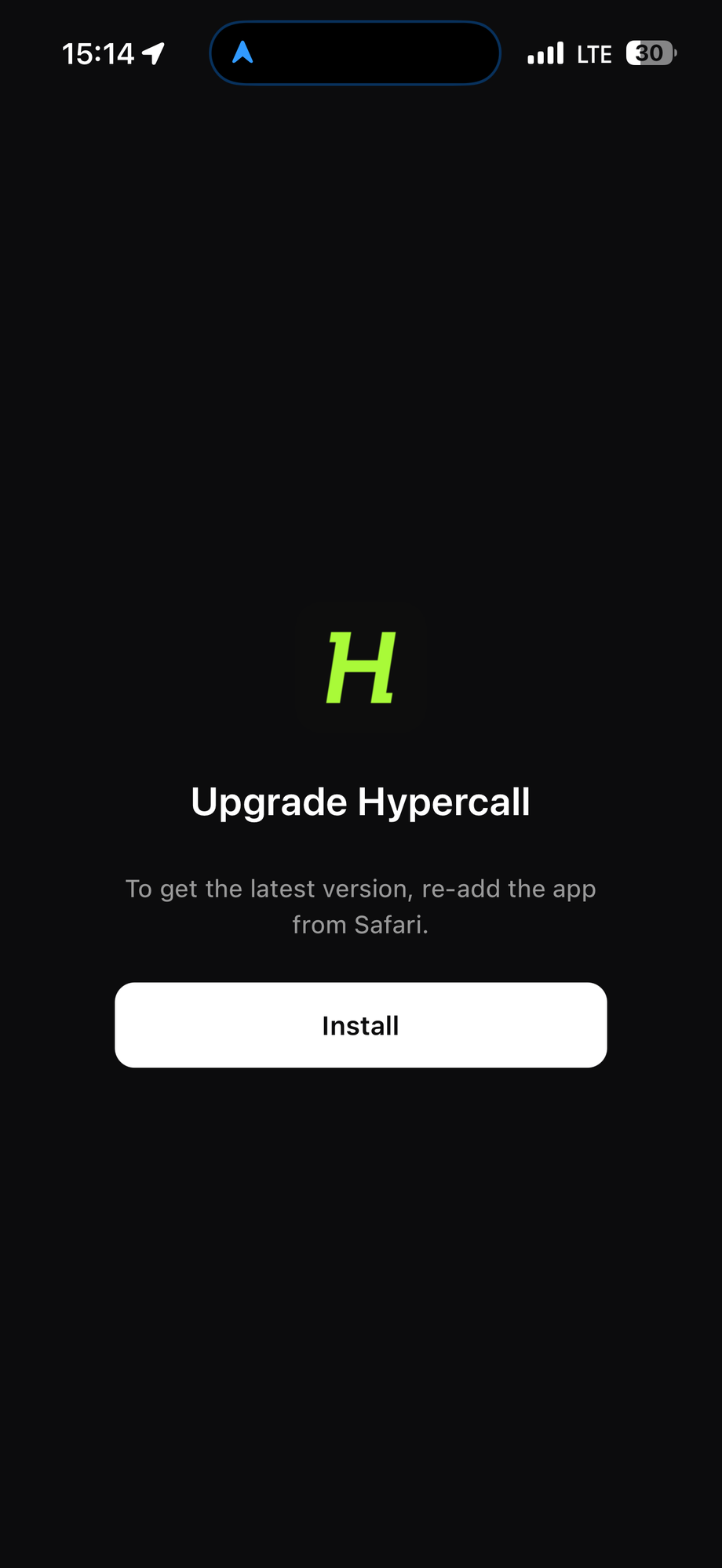
Under the hood: iOS splash screens eliminate the white flash on cold start. Navigation preload fetches the page while the service worker boots. Long-press the app icon for quick shortcuts to Portfolio and Deposit. Screen wake lock keeps the display on during trading sessions. Persistent storage prevents the browser from evicting cached assets.
Settled Position Pages
Clicking a settled position now opens a detail page with the theoretical price chart over the life of the contract, individual fill entries, and a realized P&L breakdown. Instrument names display as readable labels (“ETH $2,400 Put May 01”) instead of raw symbols.
Contract vs. Strategy Greeks
The greeks display now toggles between contract-level and strategy-level calculations. When you have a multi-leg structure, strategy mode shows the net delta, gamma, theta, and vega across all legs, so you can see the combined risk profile without doing the math yourself.
API Changes
For SDK and API users:
instrument_typeon WebSocket fill and order events ("option"or"perp")?symbol=filter onGET /profile/tradesfor per-instrument trade history- Perp fills now forwarded via WebSocket (previously missing)
- Full RFQ lifecycle via WebSocket:
SubmitRfq, quote push,AcceptRfqQuote,PlaceOrder fillsonPerpOrderResultin the Rust SDK (inline fill capture, no separate polling)
Bug Fixes
- IOC/FOK orders that partially filled were leaving ghost remainders on the orderbook. Fixed.
- Buy orders that close a short position were incorrectly reserving premium, draining equity and triggering false liquidation. Fixed.
- Expired option chains briefly appeared as Active after server restart. Fixed.
- Ticker bar movers were derived from raw BBO data, producing noisy values. Now uses theoretical price change from the options summary cache.
Insights
One new article shipped:
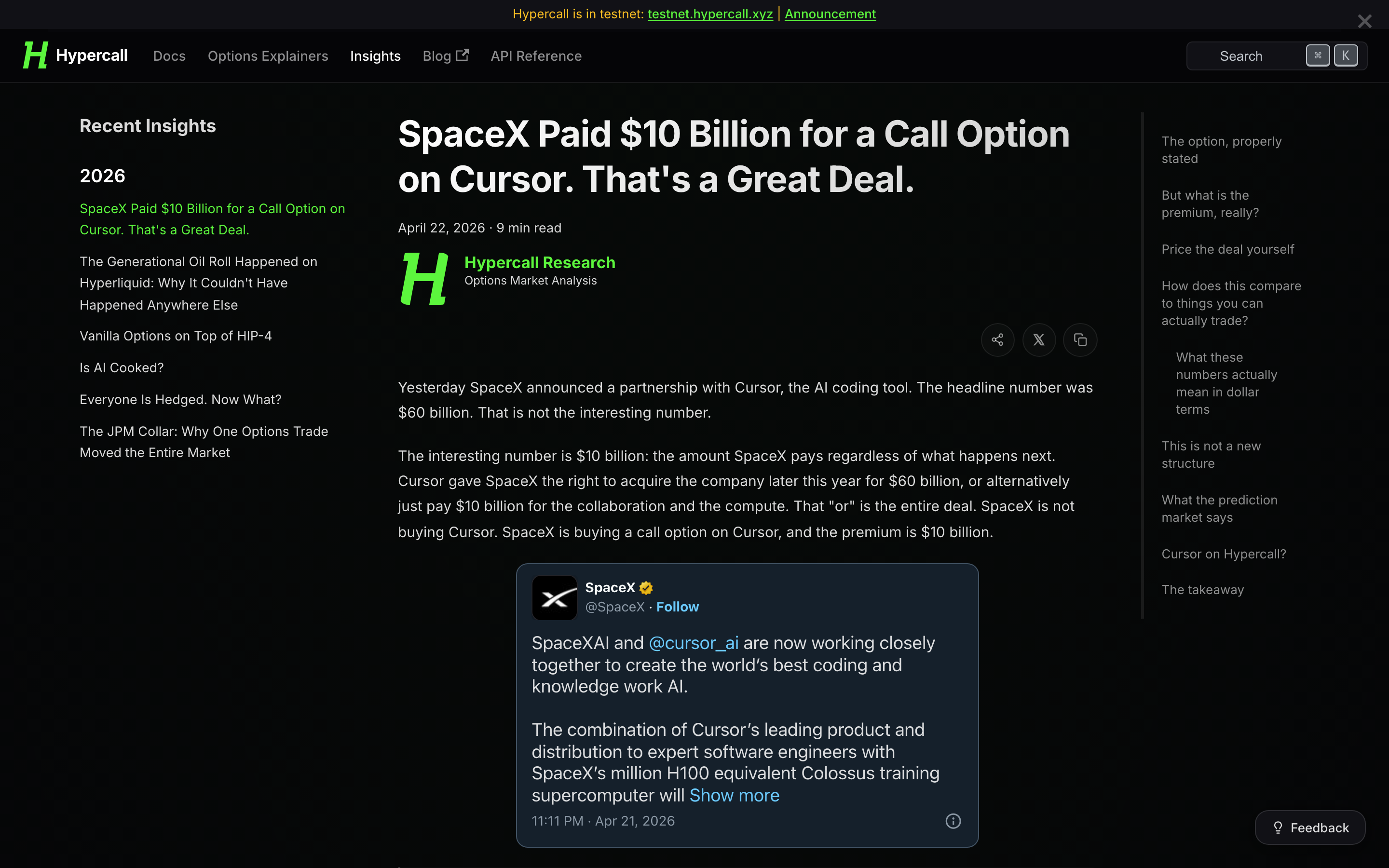
- SpaceX Paid $10 Billion for a Call Option on Cursor — decomposes the $60B acquisition right into a Black-Scholes framework. The interactive calculator lets you reprice the deal with your own assumptions, and the vol explorer compares the implied 58% vol against every asset class we can price.
Looking Forward
The competition ends May 1. Next priorities: completing the multi-leg RFQ integration so strategy orders actually route to market makers as a package, expanding the liquidation system to production readiness, and continuing to push down RFQ latency. Whitelisted mainnet launches early May.
For the full list of changes, see the v0.07-testnet changelog.