
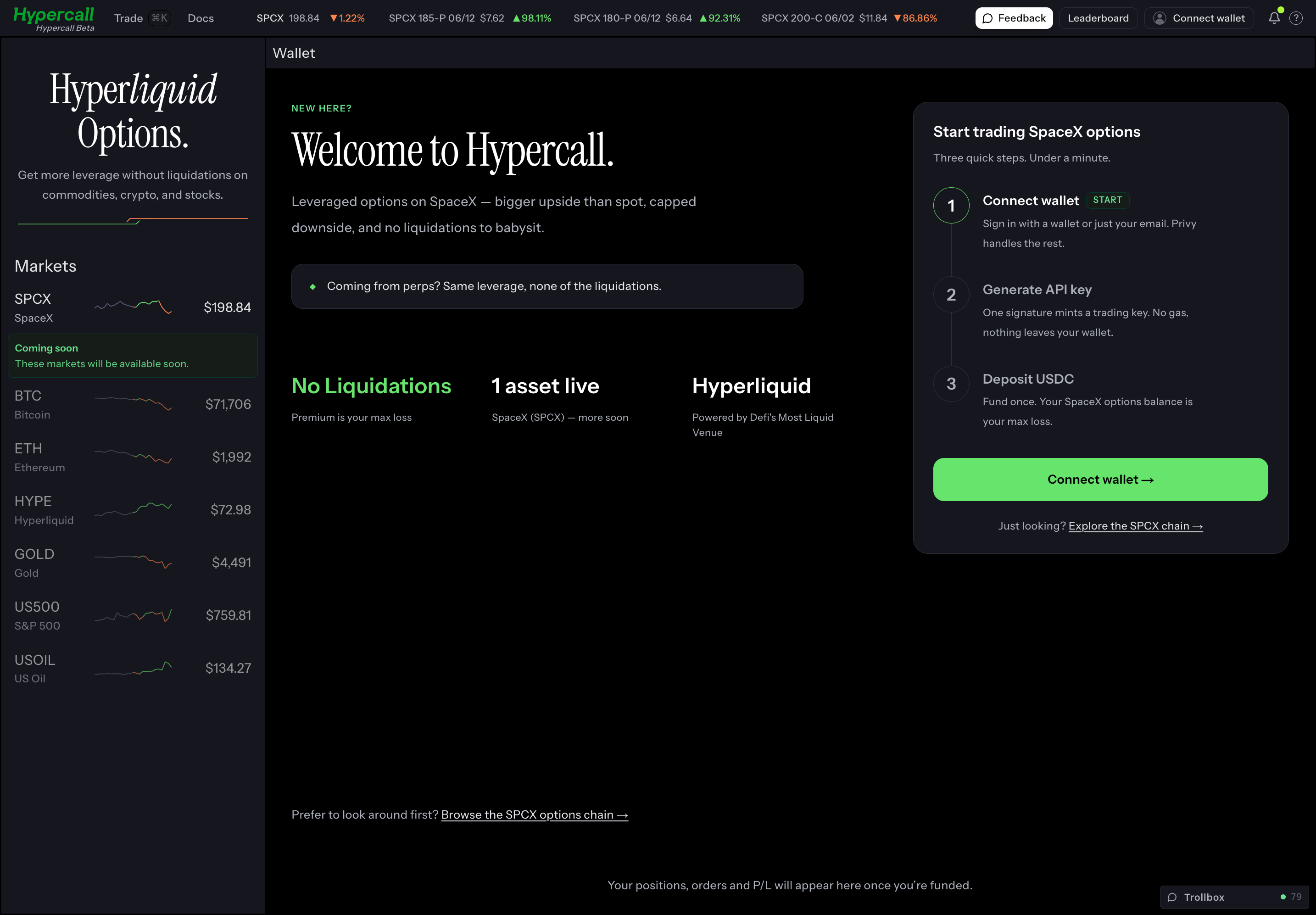
You can connect a wallet, deposit USDC, and trade SpaceX options on mainnet through SPCX.
This launch is not just a contract address or a landing page. It is the first public version of the full Hypercall loop: a live trading surface, wallet onboarding, real funding, a refreshed product site, a Foundation page, a separate Insights property, and the first market that shows why options on Hyperliquid matter.
Tl;dr
- Hypercall is live on mainnet with USDC funding and live SPCX options
- SpaceX options are the launch market: calls, puts, straddles, strangles, and spreads on SPCX
- Deposits and withdrawals are live through the new funding flow
- The trading surface has been rebuilt around strategy selection, cleaner chain interaction, new themes, normalized settings, and better onboarding
- Single-leg orders use RPI, while multi-leg packages use RFQ. The venue rules live in Order Priority
- The public surface changed too: a new homepage, a Foundation page, and a standalone Insights site at insights.hypercall.xyz
- Launch scope is intentionally limited: Hypercall is in phase 0 of its decentralization roadmap, and shorts, broad portfolio margin, and contract-level functionality remain constrained
Why SpaceX Options
SpaceX is one of the clearest examples of a market where people have a view, but the instruments are awkward.
Private-company exposure usually means brokered blocks, SPVs, long settlement cycles, high minimums, and very little ability to express convexity. A trader can want a defined-risk view on the company without wanting to buy a private placement or warehouse linear downside.
That is the gap options fill.
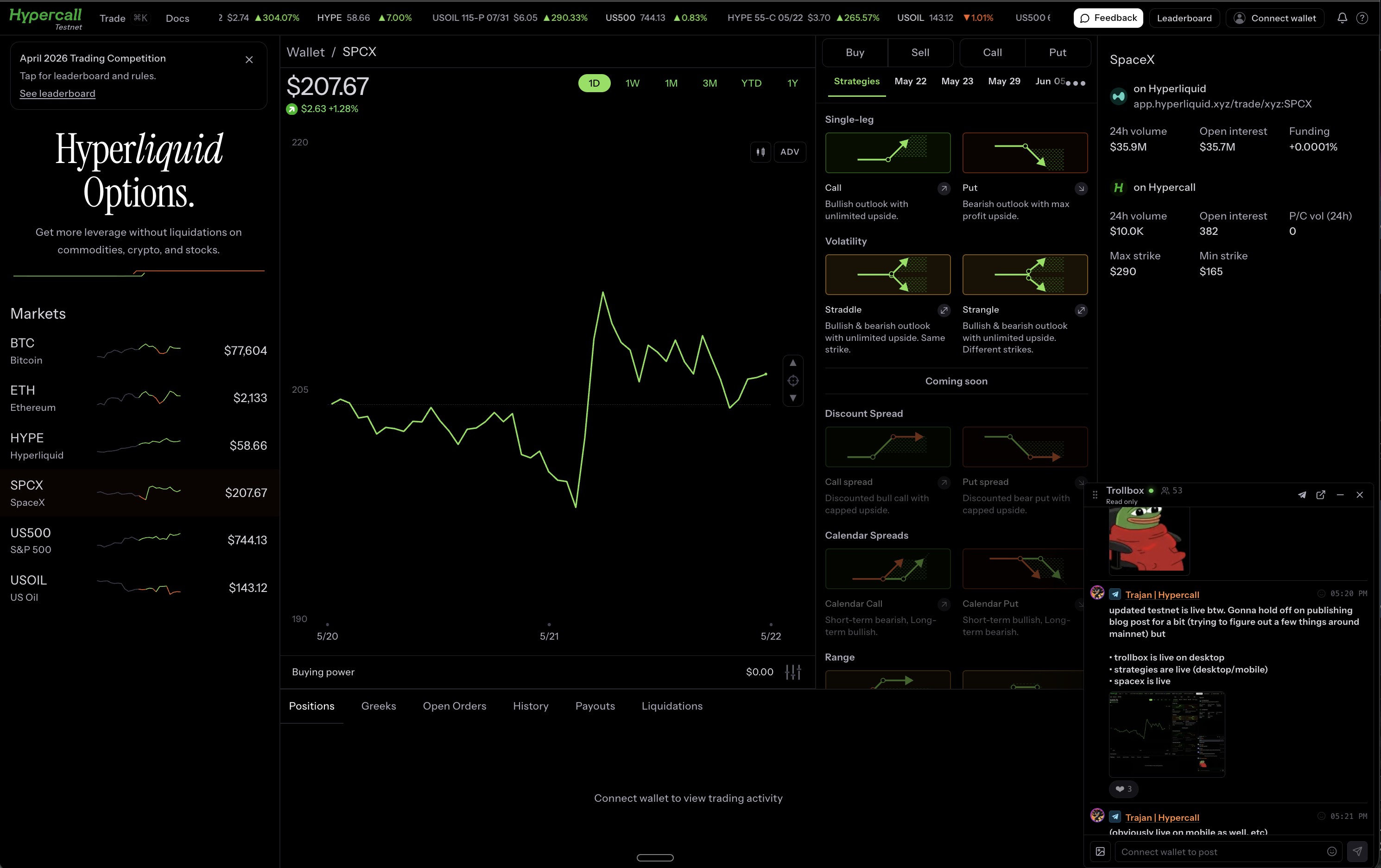
SPCX options let traders express a view on SpaceX with defined downside: calls for upside, puts for hedging or downside, and spreads for a more precise payoff. The contract is not trying to turn a private company into a public stock. It is a listed options market on top of a published underlying reference, with rules, expiries, and risk checks the venue can enforce.
The point is not just SpaceX. The point is that Hypercall can list options on assets where the underlying price exists, the market wants convexity, and traditional options infrastructure does not move fast enough.
The Trading Surface
The app is now pointed at mainnet and centered on the SPCX market.
The first-screen flow is direct: connect a wallet, generate an API key, deposit USDC, and trade SpaceX options. A user who just wants to look around can open the SPCX chain first and understand the market before funding.
The chain itself is no longer a generic table. It supports single-leg and multi-leg selection, strategy templates, sticky mark rows, date tabs, buy/sell direction, and a right-side market panel that shows the Hyperliquid underlying and Hypercall option-market stats side by side.
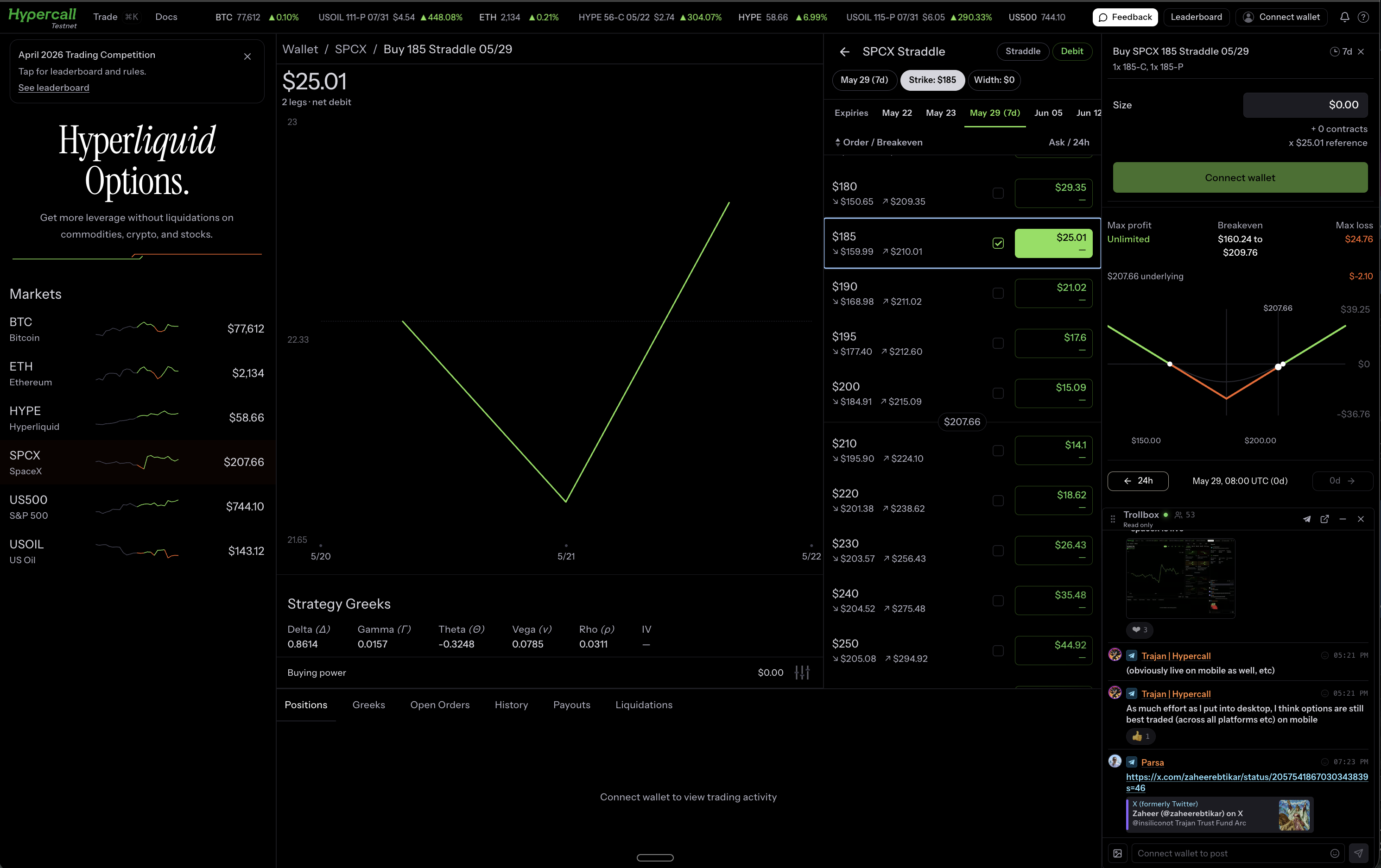
The strategy builder handles the common structures directly: calls, puts, straddles, strangles, verticals, and coming-soon calendar/discount-spread families. The point is to make option payoffs selectable instead of asking users to assemble every leg from scratch.
The rest of the surface got launch polish too: a new dark theme pass, normalized account settings, profile images, clearer funding actions, cleaner order states, and account setup that gets users into a valid margin mode with fewer steps.
Funding Is Real Now
Testnet had faucets. Mainnet has funding.
The new funding flow supports USDC deposits and withdrawals, with the bridge and relay pieces moved into the app flow instead of hidden in operator runbooks. Users can fund an account, trade, and withdraw back out. The user-facing trading guide starts in the on-app docs, while fee policy lives in Venue Rules: Fees.
The deposit modal shows the route before submission: source wallet, source chain, relay path, destination Hypercall account, estimated credit, and the action that will bridge and deposit in one flow.
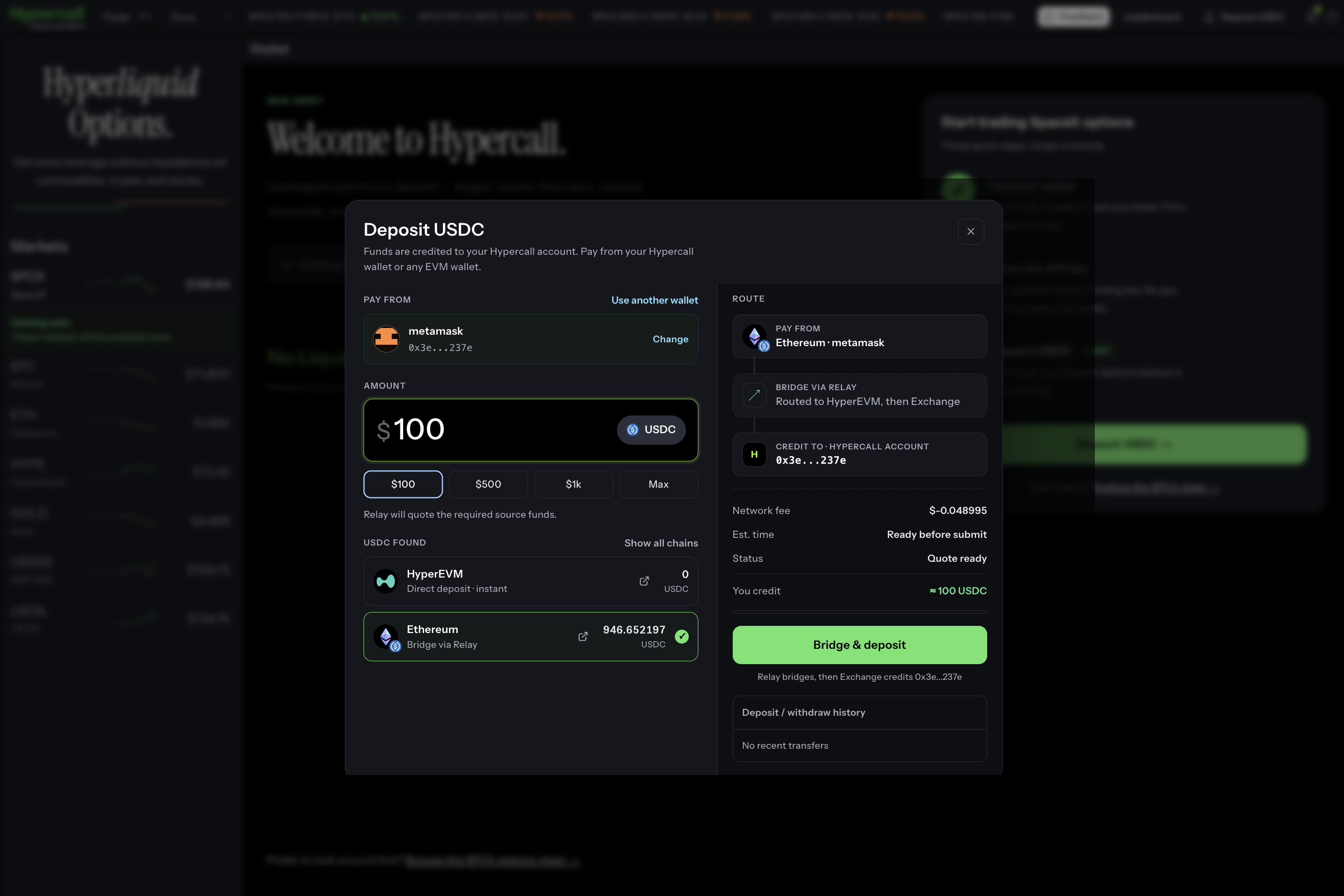
After submission, the app tracks the transfer state instead of leaving the user to infer what happened from an external transaction hash.
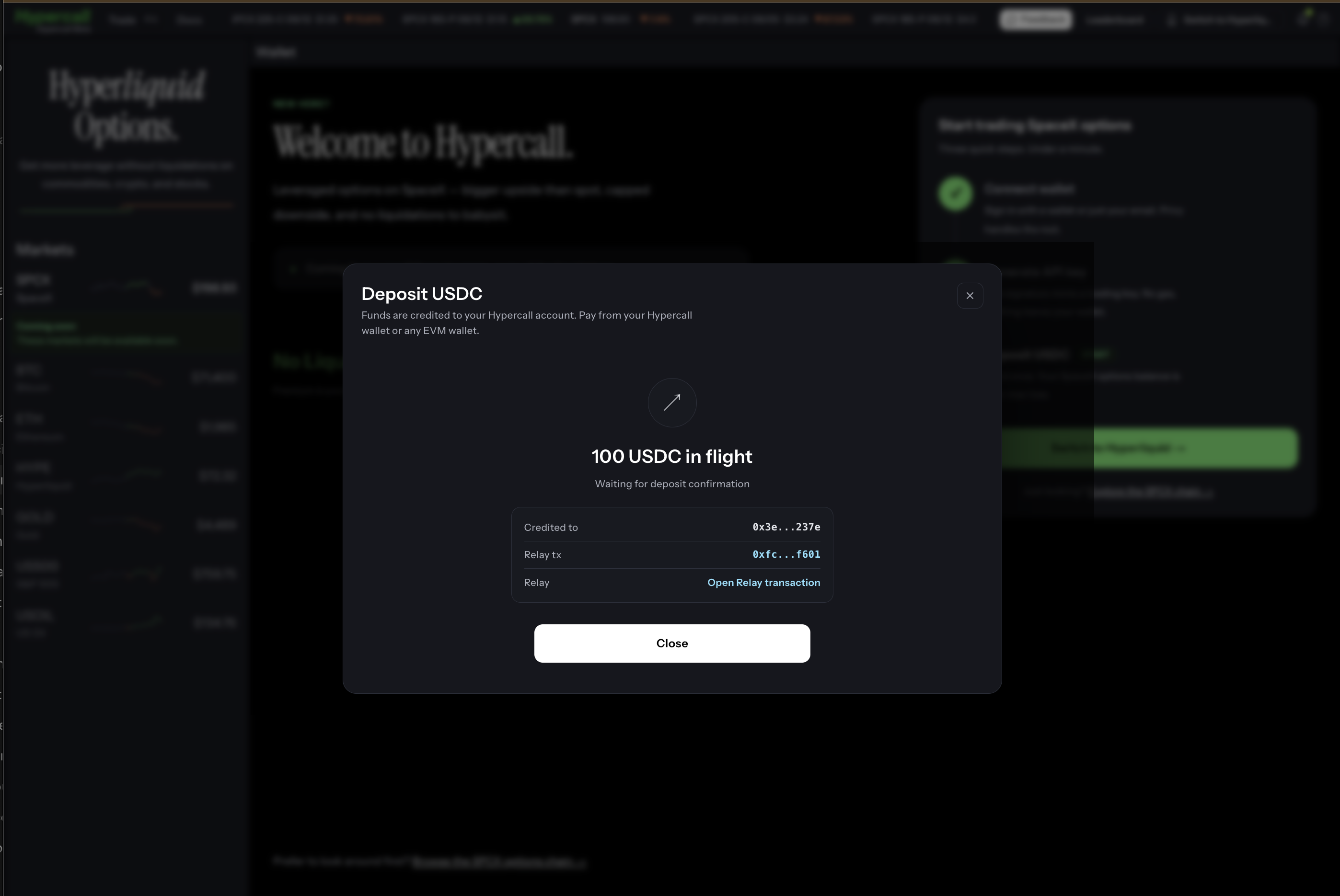
When the funds land, the account is credited and the next action is clear.
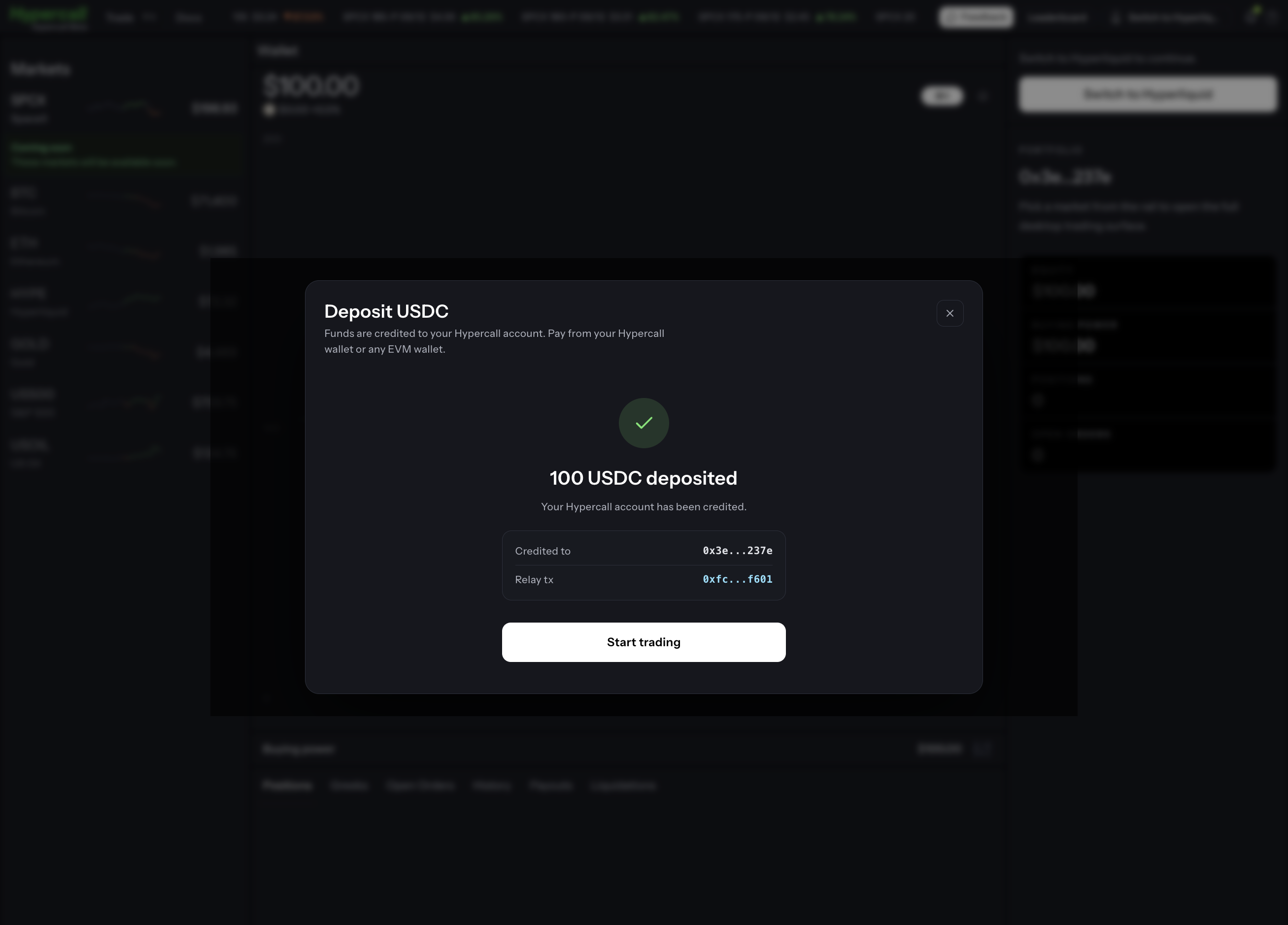
That sounds obvious, but it is the line between “try the interface” and “use the venue.” It also forced a lot of unglamorous launch work: legal acknowledgement, wallet state, deposit allowlists and caps, withdrawal tracking, account balances, and the UI states around all of it. The live legal surfaces are Terms of Use and Privacy Policy.
Execution: RPI and RFQ
Execution routes through the right mechanism for the order.
Multi-leg packages use RFQ. Single-leg orders use RPI, a short price-improvement auction where market makers can beat the best visible book price before the order falls back to the orderbook as a normal limit order. The full venue-level version is in Order Priority.
This is the split we want long term: RFQ for packages, RPI for single-leg flow, and a central orderbook underneath both. If you want the deeper version, read the full breakdown: RPI: The Execution Model Between RFQ and CLOB.
What Is Intentionally Not Live Yet
We are not launching with every feature switched on.
Day one is constrained around long premium trades. Users can buy options and defined-risk packages, while naked shorts and broad portfolio margin are held back. The reason is simple: these features are not just UI switches. They change margin semantics, liquidation, and operator risk.
The contracts are also intentionally limited at launch. Hypercall is in phase 0 of its decentralization and trustlessness roadmap: useful enough to trade, conservative enough to operate, and explicit about the parts that still rely on centralized operators and controlled rollout gates.
We will publish the decentralization and trustlessness roadmap separately. The short version is that the current launch prioritizes correctness, observability, and user exit paths before widening permissions or claiming a trust model we have not yet earned. Contract and signing docs live under Contracts and Agent Authentication.
Options venues fail when risk systems silently accept positions they cannot monitor, margin, or unwind. Hypercall is taking the opposite path: ship the path we can operate, gather evidence, then widen the venue when the controls are ready.
A New Home
hypercall.xyz has been rebuilt around the live product.
The old site explained the idea. The new site routes users into the product: live-market marquee, “Start Trading” CTA, SpaceX-first copy, payoff framing, no-liquidation education, and a clearer path from homepage to app.
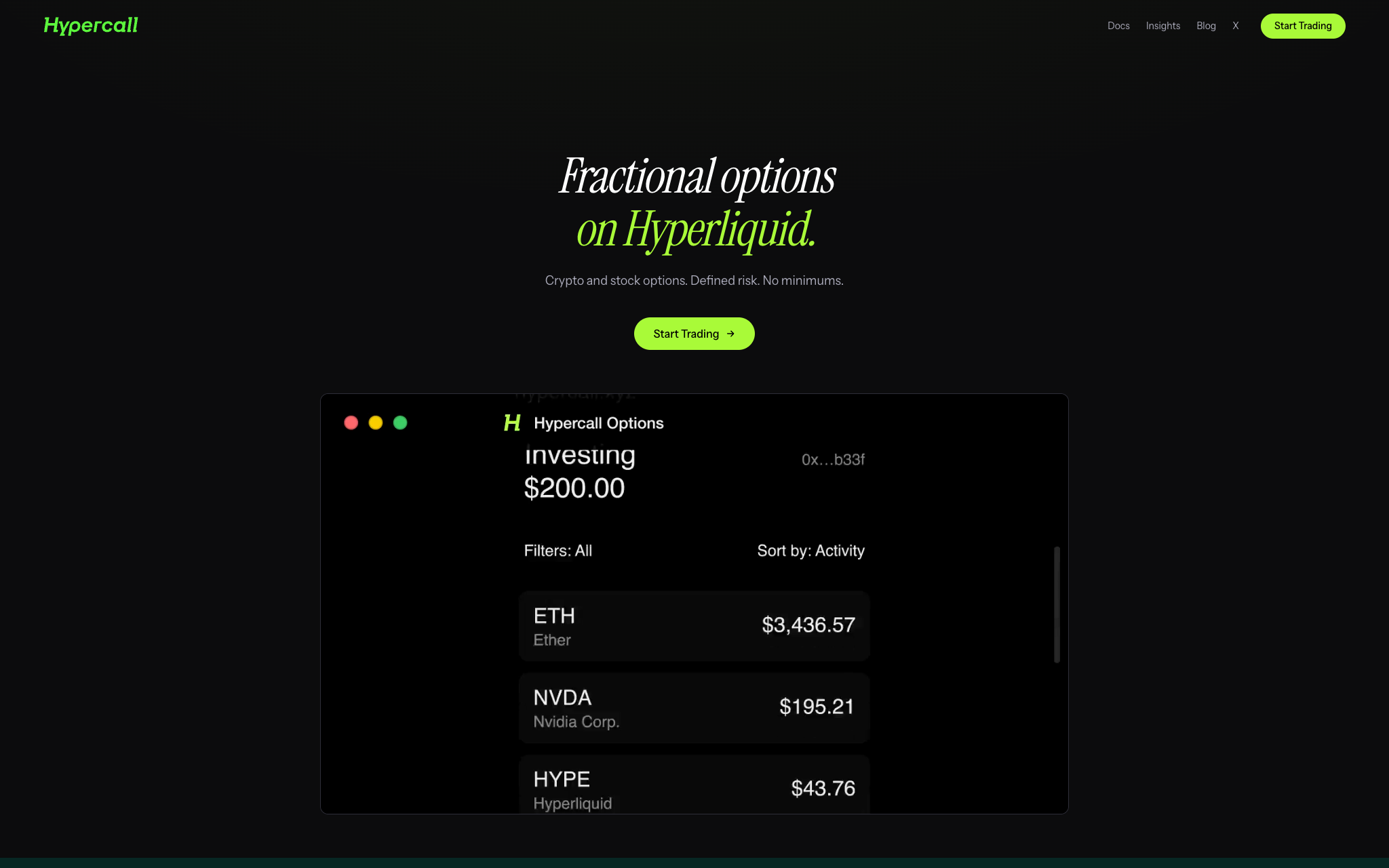
The homepage now says the thing plainly: options on anything, from any size. SpaceX is live today. More markets come after the first venue loop is proven.
Foundation Page
We also added a Foundation page for investors, partners, and ecosystem users who do not need a trading tutorial first.
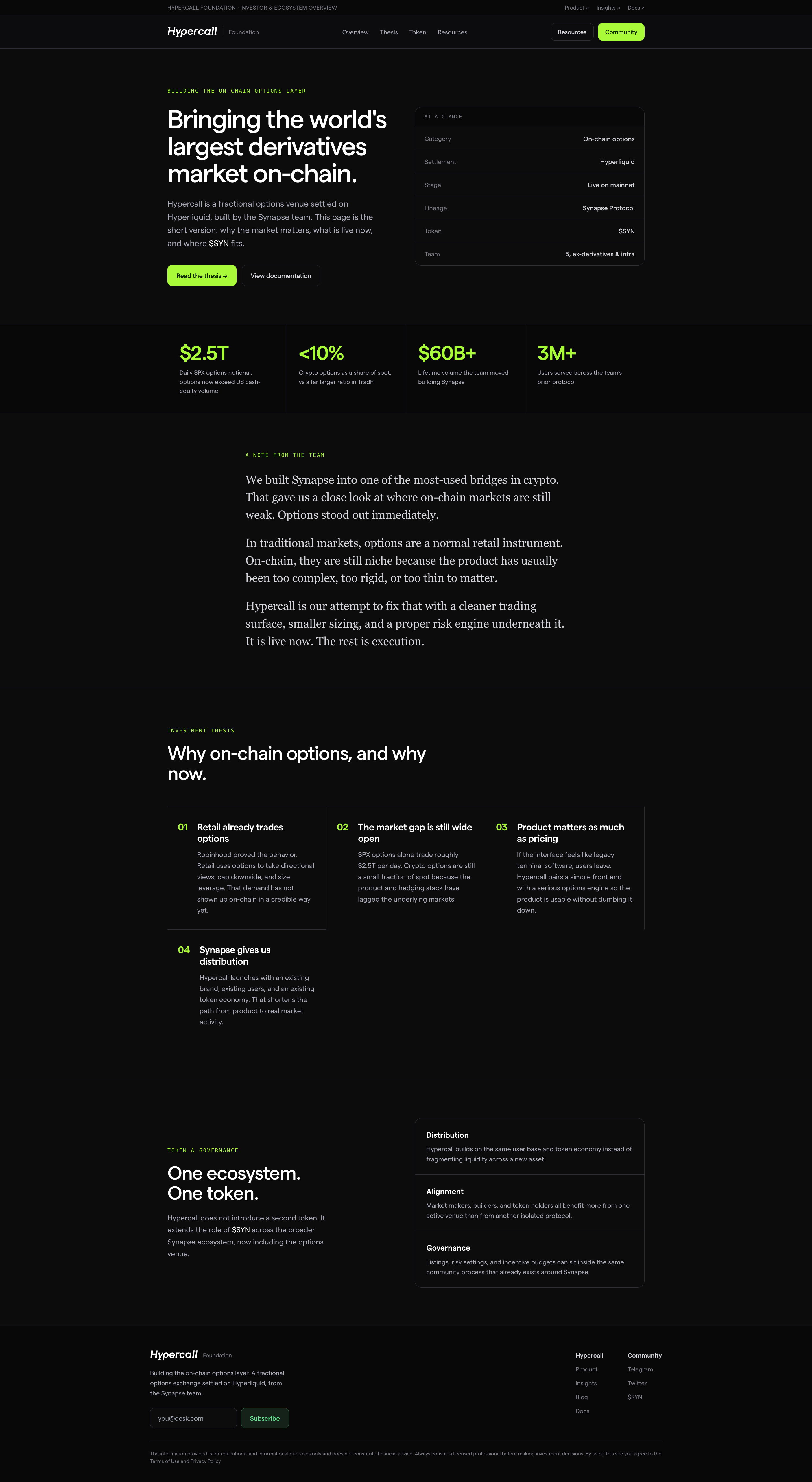
The Foundation page explains the market thesis, the relationship to Synapse, why options are still underbuilt on-chain, and what is live now. It gives the broader context for people arriving from the token, partner, or ecosystem side rather than directly from the app.
Insights Has Its Own Site
Insights moved out of the old docs/blog structure and onto its own subdomain: insights.hypercall.xyz.
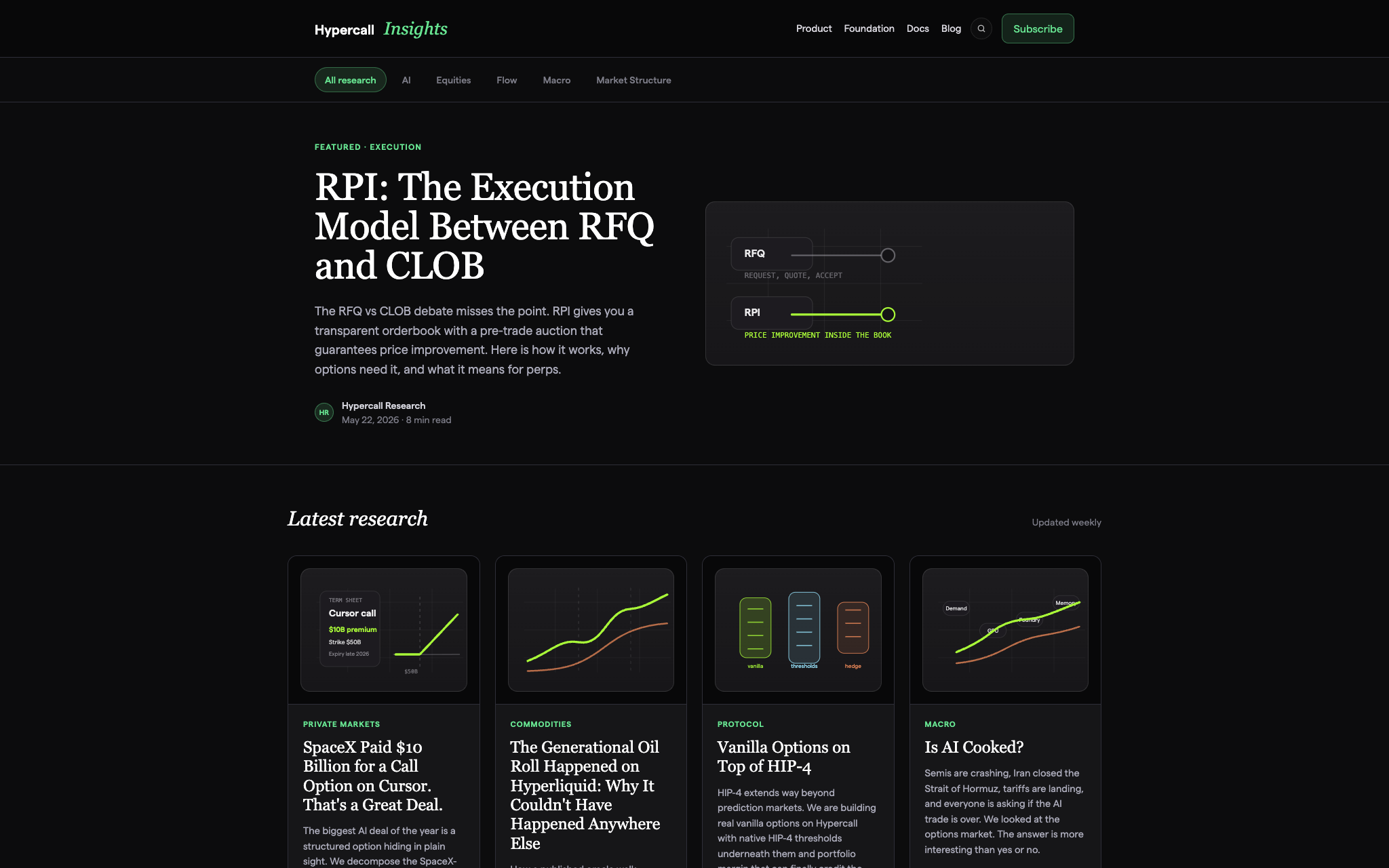
That matters because research is part of the product. Hypercall lists markets where the payoff needs context: private-company optionality, RPI execution, HIP-4 thresholds, commodities, macro, and market structure. Insights is now a proper front door for that work instead of a section buried inside docs.
The latest piece is directly relevant to launch: RPI: The Execution Model Between RFQ and CLOB. It explains the execution model behind single-leg orders on Hypercall.
What Changed Since Testnet
The visible launch is the result of a lot of product work that landed after the early testnet:
- Real USDC deposit and withdrawal flows
- SpaceX/SPCX as the first mainnet market
- Strategy templates and multi-leg selection from the chain
- RPI routing for single-leg orders
- Rebuilt order states and activity tables
- Account settings, profile images, and cleaner wallet state
- Legal acknowledgement and published terms and privacy surfaces
- New theme system and a tighter dark-mode pass
- Homepage, Foundation, and standalone Insights split
- Production auth, CSP, analytics, and mainnet environment wiring
None of those are the headline alone. Together, they are the launch.
What Comes Next
The next phase is widening the venue carefully.
That means more markets, richer strategy coverage, a clearer public roadmap, the decentralization/trustlessness roadmap, and eventually broader margin and short-option support when the controls are ready.
For now, the message is simple.
Hypercall is live. SPCX options are trading. Defined-risk options on Hyperliquid are no longer a testnet promise. Start with the app, read the trading docs, or go deeper in Insights.
This content is informational and not financial or investment advice. Trading options and digital assets carries risk.