
Trading is becoming more social.
Nansen built a business around labeled wallets. On Polymarket, a large position can become part of the event being traded. On Hyperliquid, public positions and liquidations turned whale watching into a daily market activity. Traders now follow the account as closely as the price.
A position means more when you know who owns it, how the rest of the account is positioned, and whether the order is isolated or part of a longer pattern.
Why visible flow matters
Jeff recently highlighted a study of visible TWAP execution on Hyperliquid. Davide Barone and Fabrizio Lillo reconstruct 4.3 million hidden metaorders and compare them with 465,000 visible TWAP executions in Trading in the Sunshine or in the Shade: Market Impact and Adverse Selection on Hyperliquid.
A market maker prices the risk that a large anonymous order is informed. A disclosed TWAP provides more information about the order’s schedule and intent. In the study, visible TWAPs had lower execution costs and less permanent price impact than comparable hidden metaorders. Displayed depth also increased while the visible programs were active.
Disclosure is not always the right choice. The finding is narrower: more context can reduce adverse selection and change the terms on which liquidity is offered.
Hypercall profiles do the same for options. The flow was already onchain, but following it meant starting with an address and reconstructing the account by hand. Profiles put the identity, positions, and results in one place for retail traders and whales.
What a public profile shows
Every Hypercall trader now has a public profile.
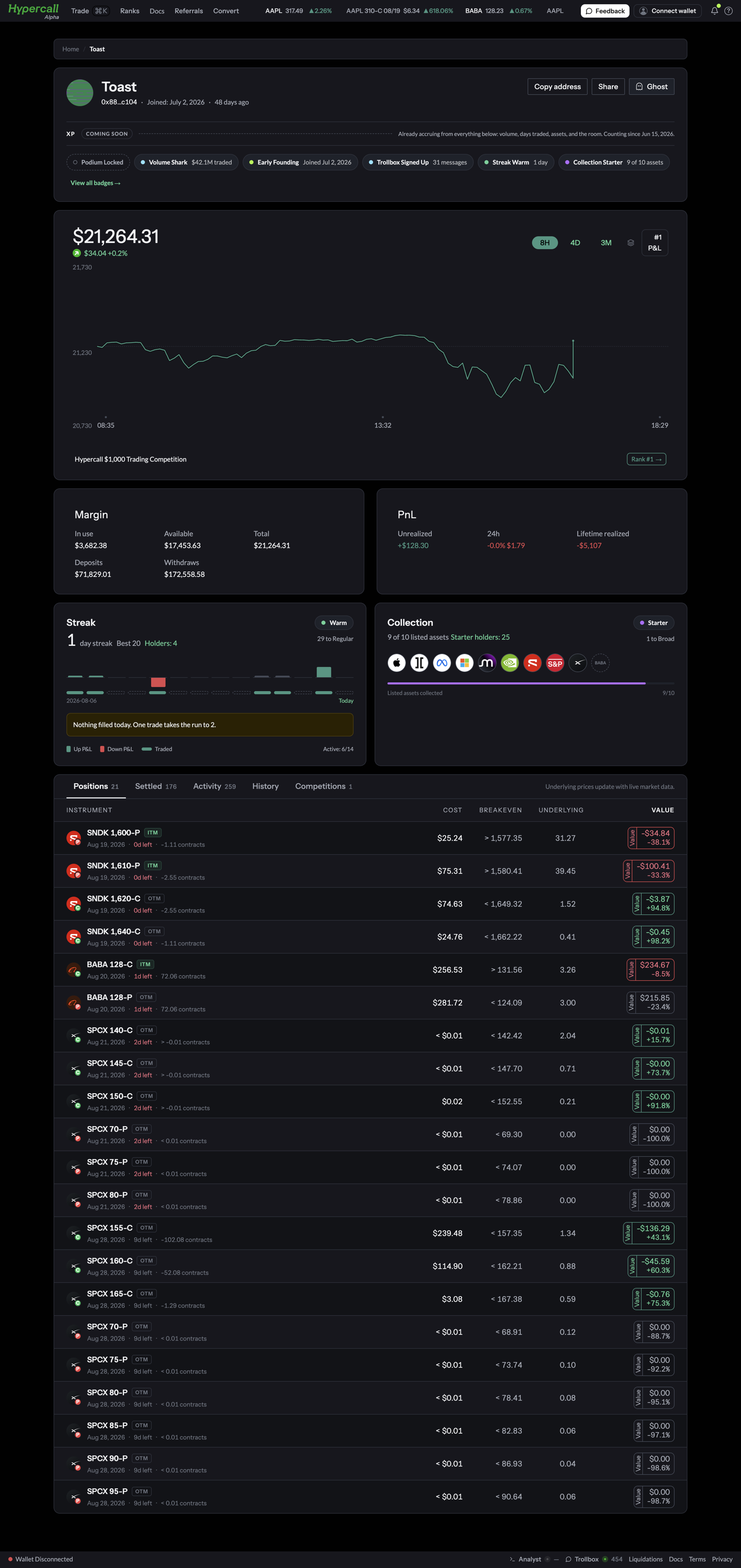
The page connects a name and address to the book the account runs. It shows account value, margin, current and settled positions, P&L, competition results, activity, order history, streaks, and collections. The owner also sees private account tools, including referrals, that visitors cannot access.
A visitor can see how the account builds and manages risk rather than relying on a screenshot posted after the trade. The trader gets a public record tied to the positions and results themselves.
Badges and collections
The detailed history is available, but it is not the fastest way to understand an account. Badges summarize facts that would otherwise require reading hundreds of fills and competition records.
There are six badge families:
- Podium records placement in a completed competition.
- Volume records lifetime notional volume milestones.
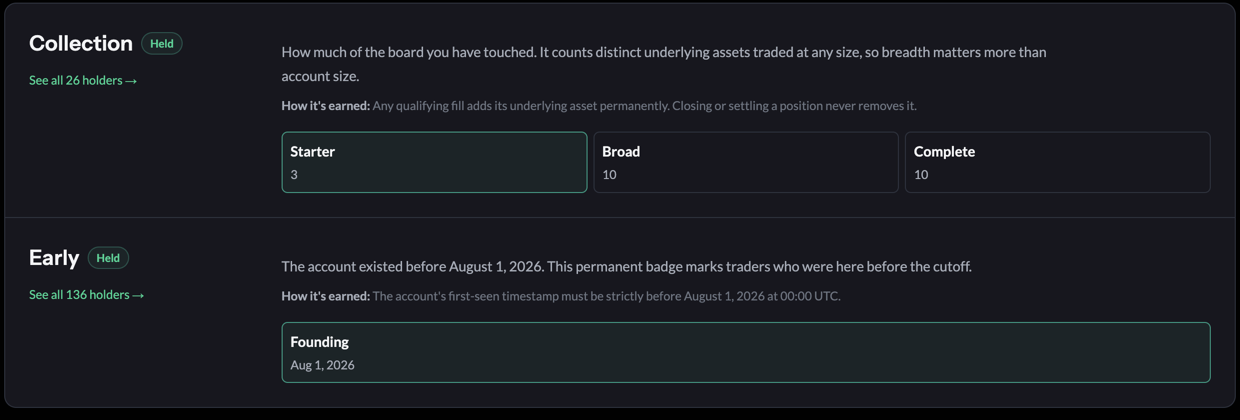
- Early shows who was active before August 1, 2026.
- Trollbox records participation in the room.
- Streak shows consecutive UTC trading days.
- Collection shows how many listed underlyings an account has traded.
Collection measures something that volume does not. A trader can generate large volume in one market; a Collection badge records breadth across the listed universe. Toast has traded 9 of the 10 listed assets.
Badges are computed from account history. Each badge page lists its thresholds, tiers, holder count, and public ranking. The profile shows both the earned tier and progress toward the next one.
The current competition
The current Hypercall $1,000 Trading Competition runs from August 18 through August 25, with $500 for first, $300 for second, and $200 for third.
As of the August 19, 16:55 UTC snapshot in the table below, 20 traders had entered the rankings and generated $890k in qualifying competition volume. Seven had cleared the prize-eligibility bar: positive competition P&L and at least $1,000 in qualifying volume.
Toast leads with 888.60 points, $710.88 in realized P&L, and $156.7k in qualifying volume. sharp_rho.85 is second with 409.36 points and $342.95 in realized P&L on $35.4k of qualifying volume. FundingRateGuy, megatron, and hollow_theta.ef complete the current top five.
The comparison between first and second shows why the board includes more than volume. Toast has traded more size. sharp_rho.85 has produced nearly half the realized P&L on less than a quarter of the qualifying volume.
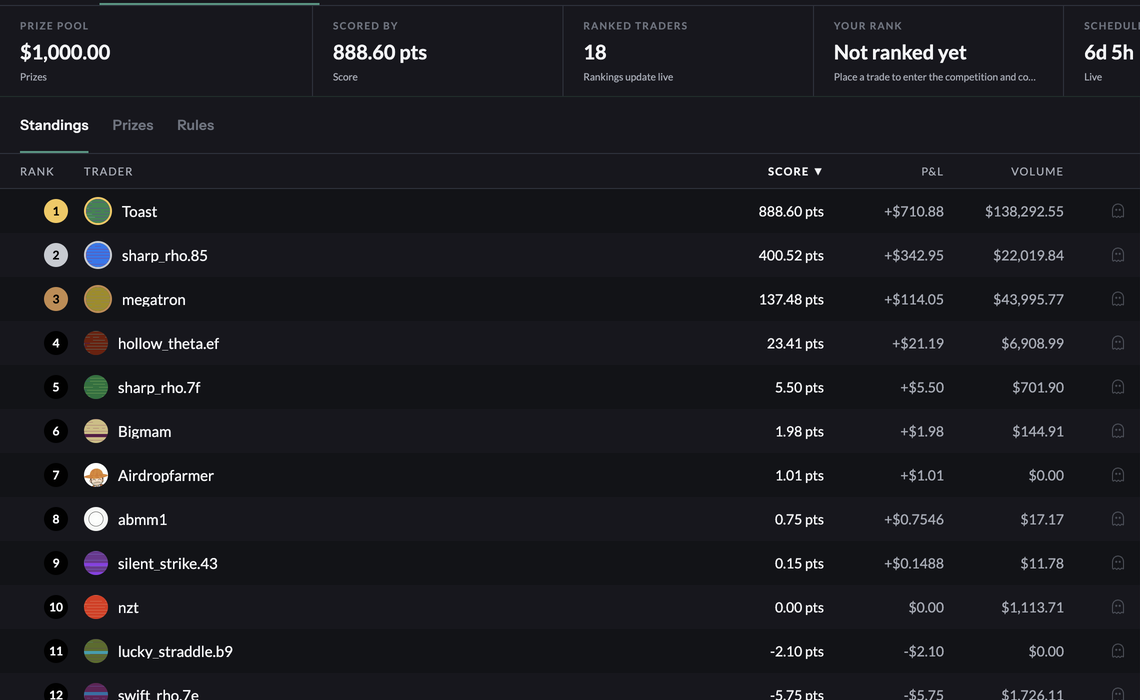
The competition is still live. These are not final standings, and the top three are not paid until the window closes. The rules explain the score, qualifying-volume cap, and prize conditions.
Positions and settlement receipts
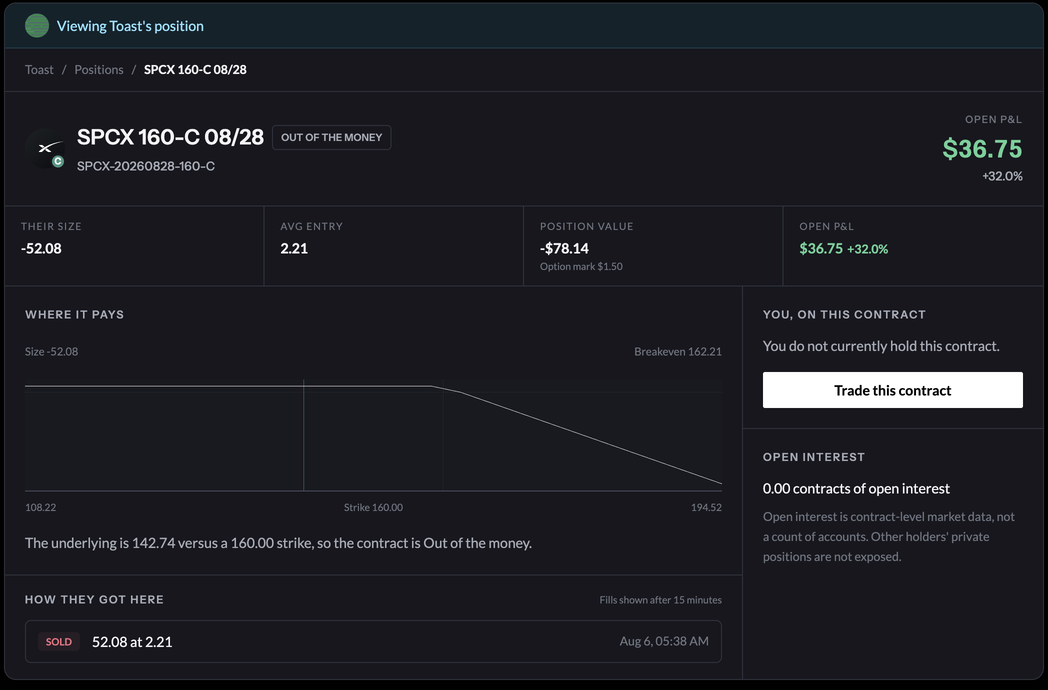
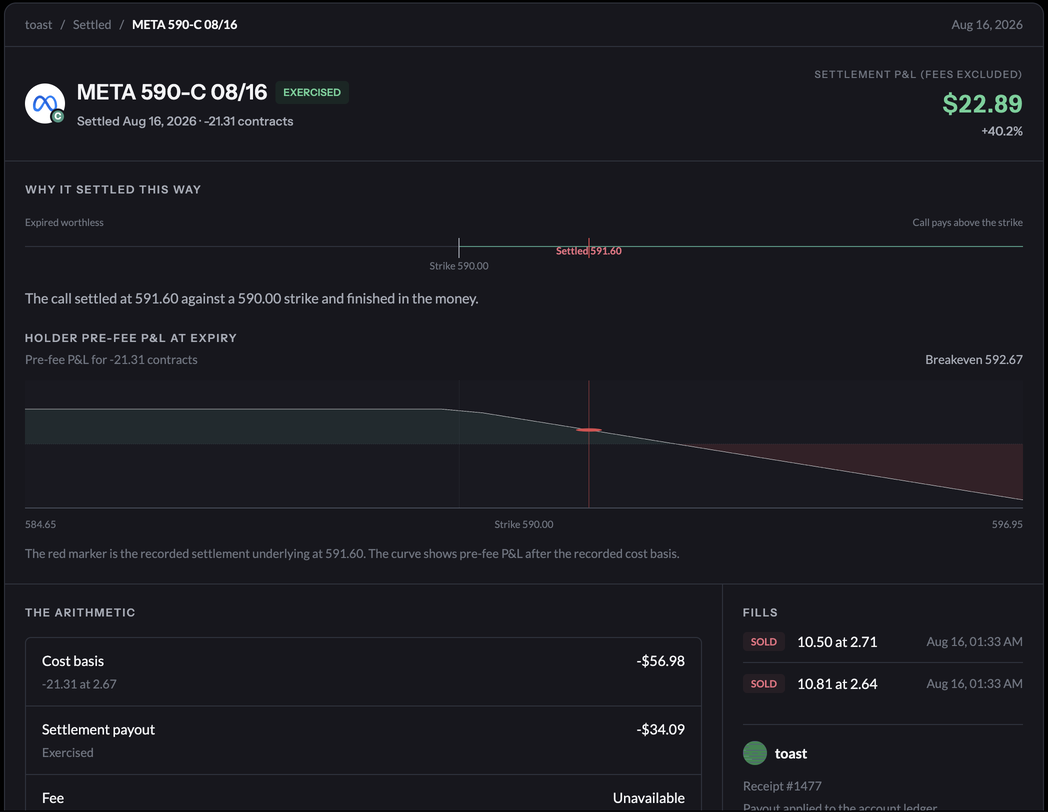
Each position on a profile links to its own page.
An open position now has its own page with signed size, average entry, current value, open P&L, breakeven, payoff, and disclosed fills. When the position belongs to somebody else, the page is visibly read-only.
After expiry, the position links to a settlement receipt. The receipt shows the exact payout record, signed position, intrinsic value per contract, cost basis, and pre-fee settlement P&L. It only renders when the payout ID, account, contract, symbol, and recorded values agree.
Trollbox search
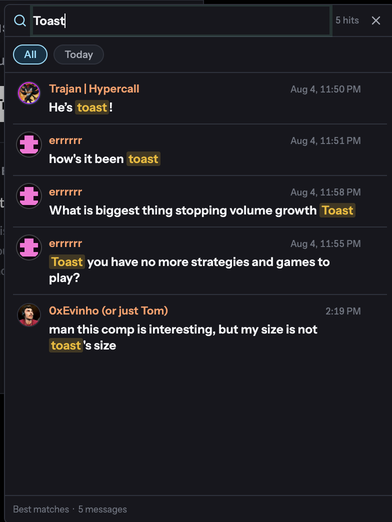
Trollbox now has ranked search. Search by trader or text, narrow results to today, and open the surrounding conversation. Analyst also receives context from the current profile, competition, badge, or contract before the first question is asked.
Most social trading still happens through screenshots, wallet links, group chats, and posts published after the move. Hypercall now puts the public record beside the conversation: profiles, positions, fills, settlements, badges, and competition scores.
The new pages are live. Start with the rankings, open a trader, and inspect the positions behind the score.
This content is informational and not financial or investment advice. Trading options and digital assets carries risk.